St Mark's C.E. Primary School Loving God - Serving others - Flourishing together
English
English Curriculum
Intent:
Intent:
At St Mark’s C.E. Primary School, we believe that writing is a powerful means of communicating, creating, exploring and expressing ideas. We want every child to see themselves as a writer and to develop the confidence, knowledge and skills to communicate effectively for a range of purposes and audiences.
Writing enables children to make their thinking visible. It allows them to tell stories, share experiences, explain ideas, persuade others, inform, entertain and communicate their understanding across the curriculum. We therefore value writing not simply as a subject to be taught, but as an essential life skill.
We have developed a bespoke writing curriculum which provides a carefully sequenced progression of skills and genres from EYFS to Year 6. This ensures that children build systematically on what they already know, revisit and secure important knowledge, and are introduced to new learning in manageable steps.
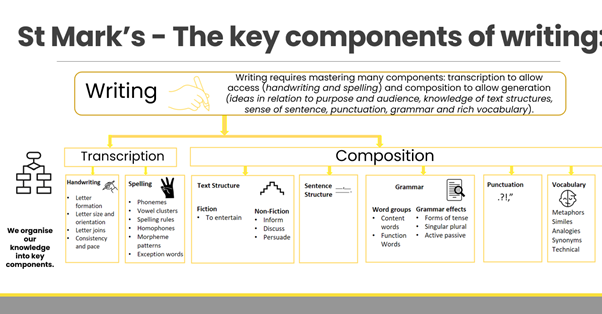
Our curriculum recognises that successful writing requires children to develop both transcription and composition. Transcription includes the foundational skills of oracy, handwriting and spelling, while composition requires children to generate and organise ideas in relation to purpose and audience, understand text structures, construct effective sentences and apply grammar, punctuation and rich vocabulary. These components work together to create writing which is accurate, cohesive and effective.
We place particular importance on securing the foundations of writing. Children need to develop fluent handwriting, accurate spelling and secure sentence construction so that these skills become increasingly automatic and do not prevent them from focusing on the composition of their ideas.
We aim for our children to:
- develop a love and enjoyment of writing;
- become confident and independent writers;
- write for a range of purposes, audiences and genres;
- develop a rich and varied vocabulary;
- understand how language choices influence the reader;
- develop secure knowledge of grammar, punctuation and spelling;
- develop fluent, legible and increasingly automatic handwriting;
- talk confidently about their ideas before and during writing;
- develop the ability to plan, draft, edit and improve their work;
- reflect on their choices as writers and develop their metacognitive skills; and
- take pride in the quality and presentation of their writing.
We provide an ambitious English curriculum for all children, including pupils with SEND. Appropriate scaffolding, modelling and support enable children to access age-related learning while developing increasing independence.
Implementation:
Our bespoke writing curriculum is carefully planned and sequenced to ensure progression in both writing skills and genres across the school.
Writing units are designed around a clear intended outcome and provide children with sufficient time to develop, practise and apply the knowledge and skills needed to become successful writers. Units will generally last approximately two to three weeks, although the length is determined by the learning rather than a fixed time allocation. We aim for no more than two main writing outcomes per half-term so that children can focus on the quality of their writing rather than the quantity they produce.
Each unit follows a carefully structured writing sequence:
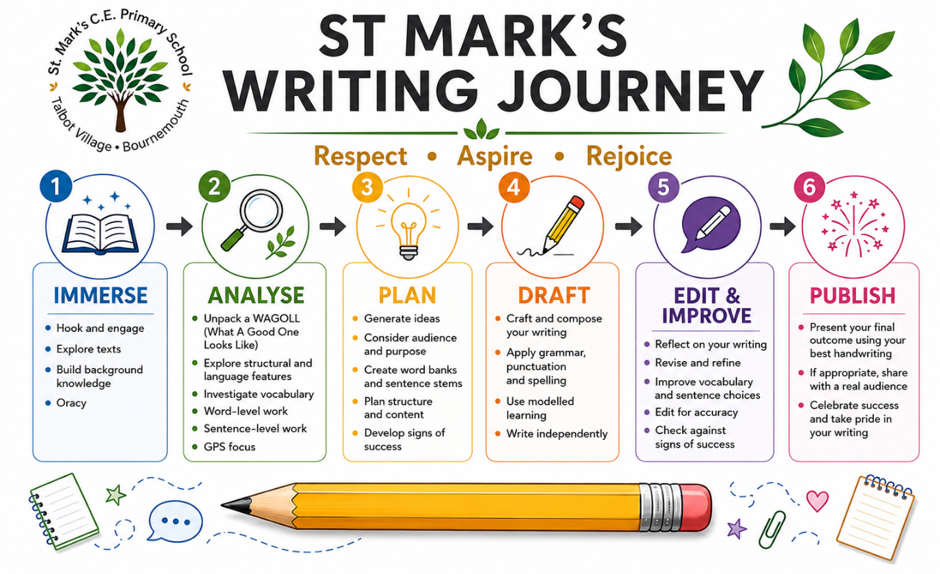
1. Immerse
Children are introduced to and immersed in a high-quality text or stimulus.
We want children to enjoy, explore and respond to what they encounter. This may include reading, discussion, drama, role play, performance and other opportunities for speaking and listening.
Oracy is an important part of this stage. Children are given time to explore ideas through talk before they are expected to record them in writing.
2. Analyse
Children explore what makes an effective piece of writing.
Teachers model and unpick carefully selected examples, helping children to identify the structural, grammatical and language features of the genre they are learning.
This stage also provides opportunities for focused word and sentence-level work. Children develop their understanding of how writers make choices and how these choices affect the reader.
3. Plan
Children gather and organise their ideas before beginning to write.
They consider, where appropriate, the purpose and audience for their writing and identify what successful writing will look like.
Children may use vocabulary banks, word banks, planning frameworks and other resources to support the development and organisation of their ideas. In Key Stage 2, pupils are given opportunities to research and develop ideas, build vocabulary banks and practise relevant sentence structures before writing.
4. Write
Children apply the knowledge and skills they have developed to produce their own writing.
Teachers use explicit modelling and carefully planned scaffolding to support children throughout the writing process. We use the principles of “I do, we do, you do” to gradually transfer responsibility from teacher to pupil.
- I do: the teacher explicitly models the skill, demonstrating how a writer thinks and makes decisions.
- We do: the teacher and children work collaboratively, rehearsing and constructing writing together.
- You do: children apply the knowledge and skills independently in their own writing.
Scaffolding is used thoughtfully to enable children to succeed while ensuring that support is gradually reduced as independence develops.
5. Edit, Revise and Improve
We teach children that good writing is developed through reflection and improvement. Children are given dedicated time to read their writing, identify areas for development and make purposeful improvements to vocabulary, sentence construction, grammar, punctuation and overall effect. Our approach encourages children to become increasingly reflective writers who can explain the choices they have made and identify how their writing could be improved.
6. Publish
Children produce a final piece of writing which demonstrates the knowledge and skills they have developed throughout the unit.
We value the presentation of children's work and celebrate high-quality writing. Children are encouraged to take pride in their work and understand that their writing has a purpose and an audience.
Teaching writing explicitly
We recognise that children need explicit instruction in the individual components of writing in order to master them.
Teachers are clear about the new learning within each unit and introduce skills gradually, building on what children already know. Previous learning is regularly revisited through flashbacks and retrieval opportunities so that important knowledge is strengthened and secured.
Scaffolding
Scaffolding is an important part of our approach to writing. Teachers provide carefully considered support to help children access new learning and experience success. This may include:
- model texts;
- shared writing;
- teacher modelling;
- sentence stems;
- word banks and vocabulary banks;
- co-constructed toolkits;
- oral rehearsal.
Scaffolds are not intended to limit children's writing. Instead, they provide the support children need while developing their independence. As children become more secure, scaffolding is gradually reduced.
Our co-constructed toolkits and working walls are developed with the children over the course of a unit. Children contribute to these resources and use them to support their own writing.
Metacognition
We want children to understand not only what they are learning but how they are learning to write.
Metacognitive talk is embedded throughout writing lessons, particularly during shared writing and teacher modelling. Teachers use think-alouds to make the writing process visible, explaining their decisions about spelling, handwriting, vocabulary, sentence construction, grammar and punctuation.
Children are encouraged to reflect on questions such as:
- What am I trying to communicate?
- Who am I writing for?
- Which vocabulary will have the greatest impact?
- How can I make this sentence clearer?
- What have I learned that I can apply here?
- What could I improve?
- How do I know this is successful writing?
Through this approach, children become increasingly able to monitor, evaluate and improve their own writing.
Oracy
Talk is an essential part of writing.
We recognise that children often need to formulate and rehearse their ideas orally before they can successfully record them in writing. The DfE Writing Framework emphasises the importance of pupils composing orally before writing, particularly while they are still developing transcription skills.
We therefore provide regular opportunities for children to:
- think, pair and share;
- rehearse sentences orally;
- discuss vocabulary choices;
- explain and justify ideas;
- respond to questions;
- develop and refine ideas through discussion;
- rehearse sentences on mini-whiteboards; and
- receive immediate feedback to address misconceptions.
Oracy supports children to construct meaning, develop vocabulary and practise sentence structures before committing their ideas to paper.
Grammar, punctuation and spelling:
Grammar, punctuation and spelling are taught systematically and explicitly across the school.
Teachers use our English planning and progression documents to ensure that they understand what learning comes before and what comes after, allowing new learning to be built systematically on secure prior knowledge.
Grammar and punctuation are taught through discrete sessions as well as being applied directly within writing units. We track coverage of the required skills and provide regular opportunities for children to revisit and apply their learning.
Spelling is taught explicitly through the systematic teaching of spelling rules and patterns. Children are expected to apply their spelling knowledge within their independent writing.
Handwriting:
We place a strong emphasis on developing fluent, legible and increasingly automatic handwriting.
Handwriting is a foundational skill which, when secure and automatic, reduces cognitive load and allows children to focus more fully on composing and developing their ideas. It also supports writing fluency, stamina and pride in presentation.
Handwriting is taught frequently and explicitly. Teachers model correct letter formation, joins, posture and pencil grip, and address misconceptions promptly. Children are expected to take pride in the presentation of their work across the curriculum.
Impact:
At St Mark’s, we want every child to develop into a confident, capable and enthusiastic writer.
The impact of our English curriculum is evident in the increasing independence, confidence and quality of children's writing. Children develop a secure understanding of the writing process and learn to apply their knowledge of vocabulary, grammar, punctuation, spelling and text structure to a range of purposes and audiences.
By the time our children leave St Mark’s, they will have:
- developed confidence and enjoyment as writers;
- experienced writing across a wide range of genres and purposes;
- developed a rich and varied vocabulary;
- developed secure knowledge of grammar and punctuation;
- developed effective spelling strategies;
- developed fluent and legible handwriting;
- learned to generate, organise and communicate ideas effectively;
- understood the importance of audience and purpose;
- developed the ability to plan, draft, edit, revise and improve their writing;
- developed the ability to talk about and reflect on their writing choices;
- become increasingly independent in applying previously taught skills; and
- developed the writing skills necessary for success across the curriculum and beyond primary school.
We want children to understand that quality matters more than quantity. We do not expect children to write at length before the foundations of writing are secure. Instead, we prioritise developing accurate transcription, sentence construction and composition so that children can gradually write with greater fluency, independence and sophistication.
Assessment and monitoring:
Assessment is an integral part of our English curriculum. Teachers use formative assessment throughout lessons to identify misconceptions, adapt teaching and provide appropriate support and challenge.
At the end of each half-term, children's independent writing outcomes are assessed against our writing progression assessment framework. This provides a clear picture of children's developing knowledge and skills and supports end-of-year judgements and moderation.
We evaluate the impact of our English curriculum through:
- ongoing formative assessment;
- end-of-unit writing outcomes;
- writing progression assessment;
- book looks and work scrutiny;
- learning walks and lesson observations;
- pupil voice;
- teacher assessment;
- whole-school tracking of progress;
- moderation within school;
- moderation across the Bournemouth Schools Trust and Local Authority;
- regular progress review meetings.
This ongoing evaluation enables us to identify strengths, address gaps and ensure that teaching responds to the needs of our pupils.