St Mark's C.E. Primary School Loving God - Serving others - Flourishing together
RSE & PSHE
Relationships and Sex Education (RSE) and Personal, Social, Health and Economic (PSHE) Education
Intent:
At St Mark’s C.E. Primary School, we value Relationships and Sex Education (RSE) and Personal, Social, Health and Economic (PSHE) education as a fundamental part of our children’s development as confident, healthy, respectful and responsible individuals.
Our RSE and PSHE curriculum supports children to develop the knowledge, skills and attributes they need to flourish both within our school community and in the wider world.
Our approach is rooted in our school vision, “Loving God and Serving others”, and our values of Respect, Aspire & Rejoice. We want every child to understand who they are, recognise their own worth, respect themselves and others, and develop the confidence to make informed and responsible choices.
Through RSE and PSHE, we support pupils to develop:
-
positive relationships with themselves and others;
-
an understanding of healthy and respectful relationships;
-
emotional wellbeing, resilience and self-esteem;
-
knowledge and understanding of physical health and healthy lifestyles;
-
personal safety and risk awareness;
-
safe and responsible behaviour online and offline;
-
the confidence to recognise and respect personal boundaries;
-
the ability to recognise when something does not feel right and know how to seek help;
-
an appreciation of difference and diversity;
-
an understanding of the opportunities, responsibilities and experiences of later life;
-
the knowledge and skills needed to become responsible members of their family, school and wider community.
Our curriculum includes the statutory Relationships Education and Health Education requirements. We also teach age-appropriate Sex Education as part of our planned curriculum.
At St Mark’s, in Year 6 the children cover the Sex Education unit to help prepare them for their transition to secondary school. Parents have the right to request withdrawal from these specific non-statutory lessons, in accordance with our RSE and PSHE Policy.
We are committed to ensuring that our RSE and PSHE curriculum is age-appropriate, inclusive and accessible to all pupils, including pupils with SEND and EAL.
Implementation:
From September 2026, St Mark’s C.E. Primary School will teach RSE and PSHE using Kapow Primary RSE & PSHE as our chosen teaching and learning programme.
Kapow provides a comprehensive and progressive curriculum from EYFS to Year 6. It supports full coverage of the statutory Relationships Education and Health Education guidance and provides opportunities for pupils to revisit and deepen their understanding as they move through the school.
The curriculum, which has been tailored to our school, provides a carefully sequenced spiral curriculum, ensuring that learning builds progressively over time and remains age-appropriate and accessible.
Our whole-school approach:
RSE and PSHE is taught through 45-minute lessons each week. This provides sufficient time to meet the statutory Relationships Education and Health Education requirements while giving children opportunities to explore important ideas, develop skills and ask questions in a safe and supportive environment.
RSE and PSHE learning is also reinforced through everyday school life. Teachers revisit and apply learning in response to real-life situations that arise in the classroom, playground or wider school community. This enables pupils to make meaningful links between what they learn in lessons and their own experiences.
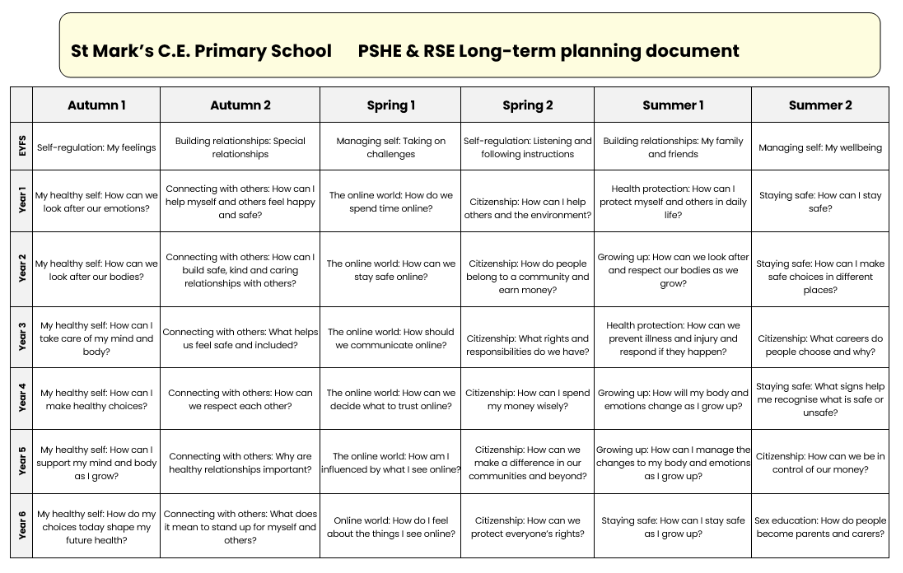
Our curriculum supports children to develop knowledge and skills across a range of areas, including:
-
relationships, friendship and family life;
-
respecting ourselves and others;
-
personal boundaries and consent;
-
mental health and emotional wellbeing;
-
physical health and healthy lifestyles;
-
puberty and growing and changing;
-
personal safety;
-
online safety and digital wellbeing;
-
recognising and managing risk;
-
peer influence and pressure;
-
seeking help and identifying trusted adults;
-
diversity, difference and inclusion;
-
aspirations and preparing for later life; and
-
first aid and personal safety.
Keeping children safe:
Safeguarding is an important part of our RSE and PSHE curriculum. Children are taught how to recognise and respect personal boundaries, recognise relationships or situations which may be unsafe, and know how and where to seek help if something does not feel right. The curriculum also reflects the changing digital world in which children live. This includes learning about:
-
age limits for social media;
-
risks associated with image-sharing and online pressure;
-
privacy and location settings;
-
online gaming safety; and
-
critical thinking about online wellbeing.
Children also develop their understanding of personal safety and managing risk, including areas, such, as rail and water safety, peer influence and pressure, and age-appropriate first aid.
Working with parents and carers:
We recognise that parents and carers play an important role in supporting children's personal development, health and wellbeing.
We are committed to being open and transparent about what we teach and when. Parents and carers are able to access our RSE and PSHE Policy, which explains our approach to RSE and PSHE, statutory and non-statutory content, parental rights, safeguarding, inclusion and assessment. In line with the updated guidance, we will provide parents with appropriate access to the RSE materials used in lessons so that families can understand and support their children's learning. We value the partnership between home and school and welcome opportunities to work together to ensure that our approach supports every pupil to flourish.
Statutory and optional content:
Further information about what is taught, parental rights and our approach can be found in our RSE and PSHE Policy. Parents can view materials use in the KAPOW scheme of learning by speaking to the school office.
Impact:
The impact of our RSE and PSHE curriculum is evident not only through pupils' work and assessment but through the way children conduct themselves and contribute to school life.
We want our children to leave St Mark’s equipped with the knowledge, skills and confidence to navigate the opportunities and challenges of modern life.
By the time our children leave St Mark’s, they will be able to:
-
understand and value themselves as individuals;
-
develop positive, healthy and respectful relationships;
-
understand and respect personal boundaries;
-
recognise when a situation or relationship may be unsafe;
-
know when and how to seek help;
-
understand how to keep themselves safe online and offline;
-
make informed choices about their physical and mental health;
-
understand the physical and emotional changes associated with growing up and puberty;
-
manage their emotions and develop resilience;
-
recognise and respond appropriately to peer pressure and influence;
-
appreciate difference and diversity;
-
challenge unfair assumptions and stereotypes;
-
demonstrate kindness, empathy and respect towards others;
-
understand their responsibilities as members of a community;
-
develop aspirations for their future; and
-
approach the transition to secondary school with confidence and appropriate knowledge.
We aim for our pupils to become healthy, open-minded, respectful, socially and morally responsible and active members of society, equipped to make positive choices and contribute to their communities.
The RSE and PSHE subject leader / SLT team monitors the impact and implementation of the curriculum through regular monitoring, including:
-
book and work scrutiny;
-
curriculum and planning reviews;
-
learning walks and lesson observations;
-
pupil voice;
-
staff voice; and
-
assessment information.
This monitoring helps ensure that RSE and PSHE is taught consistently, that learning is progressive and that pupils develop the knowledge, skills and understanding they need to flourish.